
Longevity Engineering
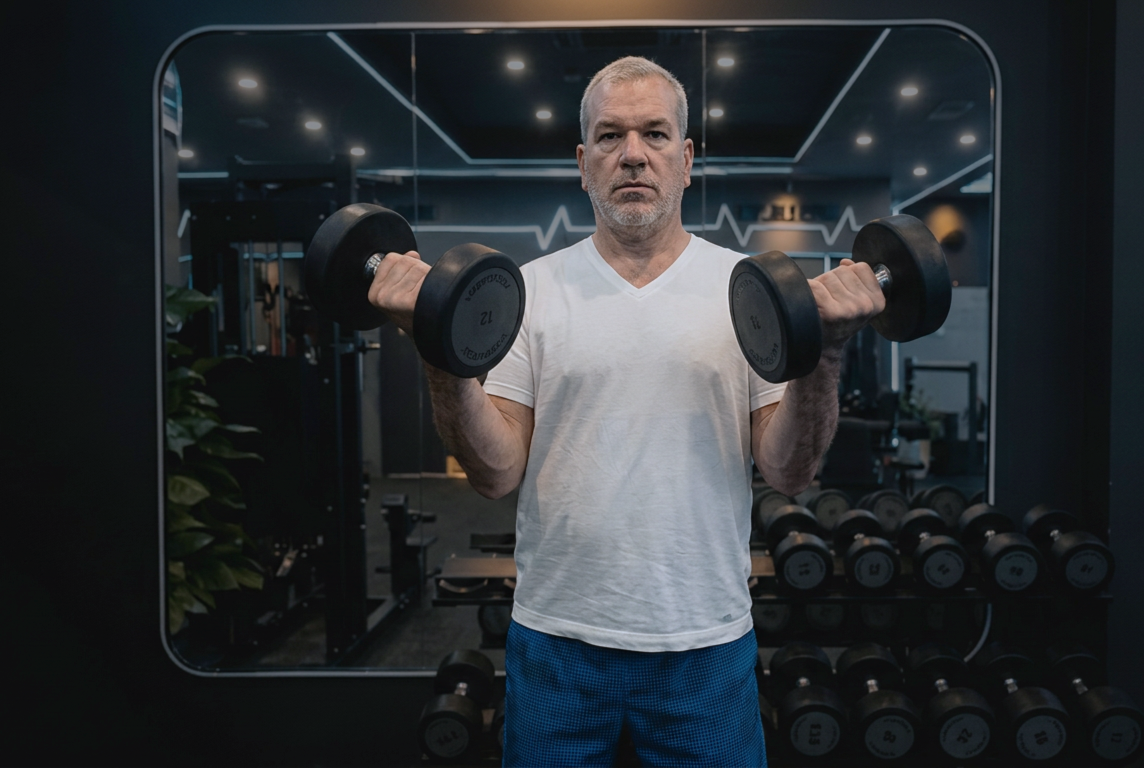
At 60+, I Play Hockey With Men Decades Younger
Don’t just “age gracefully.”
Re-engineer your life: Stay strong. Stay sharp. Stay competitive.
Not genetics. Not luck. Systems.
Stay Strong, Sharp & Competitive as You Age
A systems-based approach to staying strong, sharp, and capable after 40. No hype, no quick fixes — just engineering thinking applied to human durability.
Most people do not suddenly fall apart. They lose capacity slowly — through poor recovery, rising stress load, inconsistent training, declining sleep quality, and systems that no longer support performance. Longevity Engineering is built to help reverse that drift.
— Dan Ra, Engineer & Founder

Why this approach is worth your attention
This project was not built from theory alone. It comes from lived experience, engineering discipline, and years of testing what actually helps a person stay capable under real-life load.
Still Playing Competitive Hockey
at 60 +
55 bpm
Resting heart rate
No
No medications
Built by an engineer
not a hype marketer
When the right systems are maintained, the outcomes are visible — in how you perform, how you recover, and how you look and feel.
Why capable people start slipping
Decline usually does not begin with disease. It begins with small losses that accumulate: worse sleep, less recovery, more background stress, weaker training consistency, reduced energy, and lower tolerance for pressure. The result is not just aging — it is system failure in slow motion.
- You still work hard, but recover worse
- You still train, but results come slower
- You still push, but the cost is higher
- You still function, but feel less durable
A different approach to longevity
Most health advice treats symptoms one by one. Longevity Engineering treats the body and mind as an integrated operating system. Instead of chasing hacks, this framework helps you rebuild the systems that support strength, recovery, focus, stress tolerance, and long-term performance.
One system that most frameworks ignore entirely is inner regulation — the capacity to manage psychological load, recover mentally between demands, and maintain a stable baseline under pressure. Without this, no training protocol, sleep system, or recovery routine can reach its full effect. It is the foundation that makes everything else sustainable.
The goal is simple: not just to live longer, but to stay capable, resilient, and fully effective for longer.
Start here
If you are new to the project, begin with the Biological Age Quiz. It takes 3 minutes, shows you where your system is strong and where it is losing ground, and unlocks your personalized free Starter Kit.
Biological Age Quiz
Find out whether your current habits and recovery patterns are helping you age better or pushing you toward faster decline. Takes 3 minutes — results immediately, no email required.
Free Starter Kit
Unlocked after the Quiz. A personalized entry point into the Longevity Engineering approach — practical protocols matched to your results, plus direct links to the Template Pack and the systems most relevant to where you stand right now.
Systems Overview
See the bigger framework behind the project and how the 10 major systems work together.
Current Tools & Products
The site includes free starting points and practical paid tools designed to help you apply the framework—not just read about it.
| Label | Product | Description |
|---|---|---|
| FREE | Biological Age Quiz | A fast self-assessment — results immediately, no email required |
| FREE AFTER QUIZ | Starter Kit | Your personalized entry protocols — unlocked after the Quiz, delivered to your inbox, with direct links to the relevant systems and Template Pack |
| PAID | Template Pack | Practical templates to think clearly, track what matters, and build repeatable systems. |
| PAID | Complete Framework | All 10 interactive systems combined into one coordinated operating system for long-term human durability. |
Results from the field
The framework is designed to produce measurable outcomes — in performance, recovery, energy, and how you look and feel. Here is what consistent system application looks like in practice.
Recovery fully maintained
Training 5–6 days per week with no accumulated fatigue. Consistent application of the recovery and load management protocol.
Dan R., 60+, Toronto — system designer, 20+ years of tracked application
Sleep consistency at 7–8 hours/night
Maintained across travel and time zones. Sleep optimization and stress load system applied together.
Dan R., 60+, Toronto — documented across multiple years of tracking
Training frequency increased
Without joint pain or injury. Movement programming and joint protection system rebuilt from first principles.
Dan R., 60+, Toronto — current ongoing result
These are not exceptional cases. They are what happens when the right systems are maintained consistently.
The system behind the work
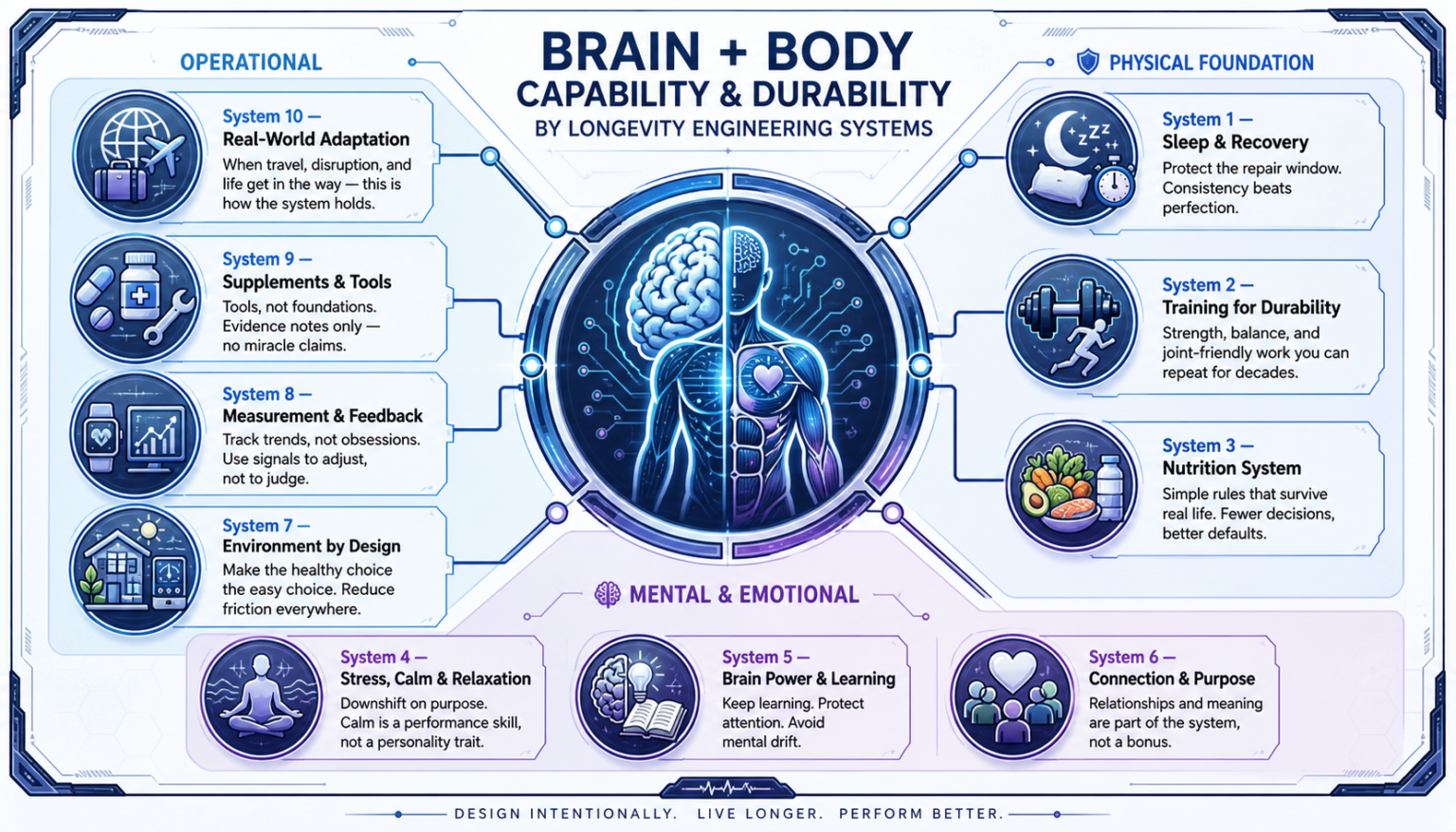
This project is built around a 10-system framework organized into three categories: Physical Foundation, Mental & Emotional, and Operational. Each system addresses a specific part of long-term capability — from sleep and training to stress regulation, brain performance, environment design, and the practical realities of staying consistent when life gets in the way.
Health is not one habit. It is a coordinated system.
Research notes and field insights
The Journal collects essays, observations, and research notes on aging, training, stress, resilience, recovery, and practical durability. It is where ideas are tested, refined, and connected back to the larger framework.
- June 2026
Recovery Debt: The Hidden Cost of Pushing Through
How small recovery deficits compound over weeks and months — and what the data shows about reversing them.
- June 2026
Stress Load Calibration After 40
Why the same stressors hit differently as we age — and a practical framework for adjusting your load.
- June 2026
Inner Regulation: The Missing System
Most longevity frameworks ignore psychological recovery. Here’s why that’s a critical oversight.
Know where you stand
If you want a practical starting point, begin with the Biological Age Quiz. It is the fastest way to see whether your current approach is moving you toward durability or decline.
Weekly Insights on Systems, Training, and Long-Term Thinking
Join the newsletter for practical frameworks on strength, recovery, mental performance, and
designing a life that stays capable for decades.
No spam. No hype. Just what works.
The Solution
Journal
Long-form reflections on aging without panic, physical adaptation, routines that survive real life, and movement without obsession.
Written slowly. Updated intentionally.
Systems
Clear, practical frameworks for daily movement, strength training designed for joints and longevity, walking and recovery rhythms, mental performance, and managing energy instead of chasing productivity.
These are structures, not prescriptions. Test what fits.
Adjust what doesn't.
Field Notes
Short observations from daily life: training, travel, climate, routine disruption, and the aging signals most people ignore.
This is lived experience, not theory.
THE SOLUTION
Longevity Engineering is the art of designing a life where health becomes the path of
least resistance. It rejects the idea that a long life requires constant suffering, extreme discipline, or heroic willpower.
Instead, life is treated as a system, built for reliability over peak performance. The focus is on low-wear routines, simple structures, and choices that remain sustainable for decades, not weeks.
When health is supported by systems rather than motivation, it stops feeling like a
project. It becomes quiet background maintenance, allowing strength, clarity, and energy to compound naturally over time.
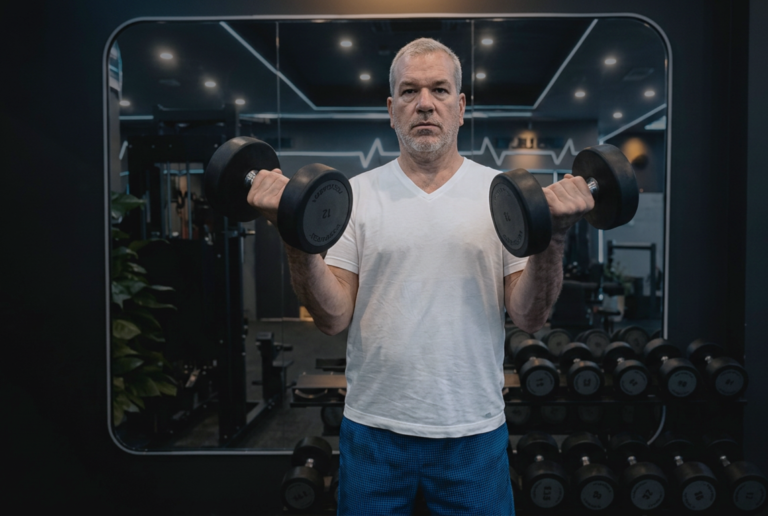
This is how I’ve stayed competitive at 60+ — and it’s the approach I share here.

What You’ll Find Here
Journal
Long-form reflections on aging without panic, physical adaptation, routines that survive real life, and movement without obsession.
Written slowly. Updated intentionally.
Systems
Clear, practical frameworks for daily movement, strength training designed for joints and longevity, walking and recovery rhythms, mental performance, and managing energy instead of chasing productivity.
These are structures, not prescriptions. Test what fits.
Adjust what doesn't.
Field Notes
Short observations from daily life: training, travel, climate, routine disruption, and the aging signals most people ignore.
This is lived experience, not theory.
What This Is Not
Longevity Engineering is not medical advice, a fitness program, or a promise of optimization. It avoids extremes, constant intensity, and influencer-style wellness. The focus is on clarity, sustainability, and systems that hold up in real life — not trends that fade when the hype cycle moves on. If something sounds too exciting or too urgent, it probably doesn’t belong here.
Who This Is For
This project is for people who want to stay capable for the long run—physically and mentally—using calm, repeatable systems.
This is for you if you:
- Want to slow unnecessary decline and keep building durability over time
- Prefer being competitive (in sport, work, or life), not just “active for your age”
- Are tired of fitness trends that ignore joints, recovery, and sustainability
- Value evidence, feedback, and systems over hype
- Are willing to think long-term and stay consistent
You don’t need to be a professional athlete. You don’t need perfect genetics. You don’t need to start young. You just need to build deliberately—then repeat what works.
If you’re 40, 50, 60, or beyond, and you’re tired of being told “it’s just aging,” this is for you.
The Long View
Longevity is not built in dramatic moments.
It emerges slowly, often unnoticed.
In how you move through ordinary days.
In how you think, pause, and respond to what happens.
In choosing rest when effort is available.
In simplifying when adding would be easier.
Longevity Engineering exists to notice, shape, and live that process over time.
Invitation
If this way of thinking resonates, you’re welcome to follow along. Start with the newsletter — weekly insights on systems, training, recovery, and long-term thinking:
Or explore the Journal and Systems pages to see if this approach fits. Read what resonates.
Adapt what works. Ignore what doesn’t.
This is not a program. It’s a perspective. And it compounds over time.